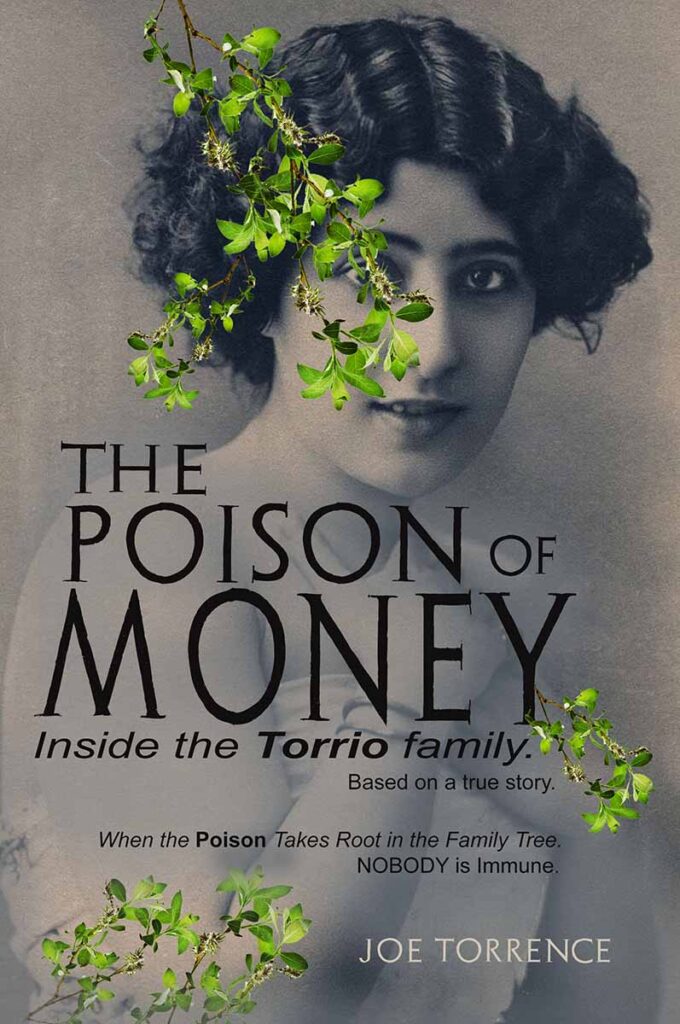
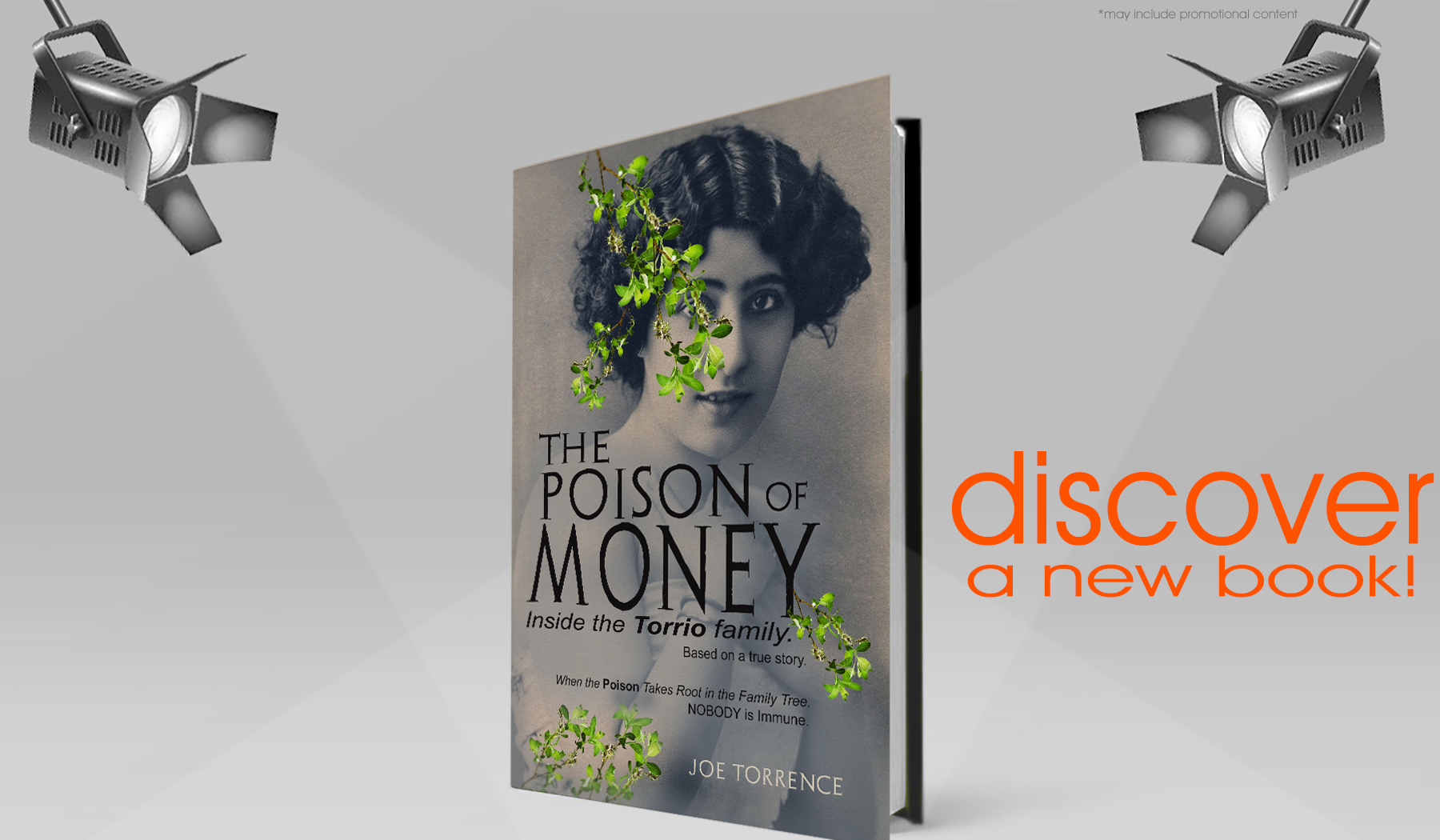
The Poison of Money by Joe Torrence
Inside the Torrio Family, the Myth of Power, and the True Cost of Wealth
Some stories are passed down. Others are buried.
The Poison of Money is the rare book that does both, then quietly asks what it costs a family to live with the difference.
Written by Joe Torrence, the great-nephew of legendary Prohibition-era power broker Johnny Torrio, this sweeping historical narrative moves far beyond the familiar mythology of organized crime. It is not a mob biography, and it is not a glamorized crime saga. Instead, it is a multi-generational exploration of money, power, silence, and the long shadow they cast over families who lived too close to history.
At its core, The Poison of Money is a book about inheritance. Not of wealth, but of consequence.
Who Was Johnny Torrio, Really?
In popular culture, Johnny Torrio is often reduced to a footnote. The mentor of Al Capone. The strategist behind Chicago’s criminal empire. A name spoken with casual authority.
Joe Torrence complicates that image.
In The Poison of Money, Torrio is portrayed not as a caricature of excess, but as a methodical, intelligent, and deeply controlled figure. A man who understood systems better than people. A man who read legislation the way others read weather patterns.
The book opens in 1919, on the brink of Prohibition, when the United States voted itself dry. Torrio immediately recognizes what many did not: the law was not a barrier, but an invitation. Where others saw moral reform, he saw infrastructure failure, loopholes, and opportunity.
This framing is essential. Torrio is not driven by chaos or addiction, but by calculation. And that makes him far more unsettling.
Prohibition, Power, and Respectability
One of the book’s most striking accomplishments is how it reframes corruption as polite.
Golf courses, country clubs, cigars, judges, police captains, politicians. The early chapters place power in clean spaces, among men who believe themselves respectable. The violence that follows does not erupt suddenly. It unfolds as a consequence of entitlement and proximity.
Money, Torrence suggests, does not announce its poison. It seduces first.
Rather than leaning into spectacle, these scenes expose how authority quietly bends when comfort is involved. Laws exist. Enforcement exists. But loyalty, access, and wealth move more efficiently than any statute.
This is where The Poison of Money begins to distinguish itself from traditional crime histories. It is less interested in what Torrio did, and more interested in how easily the world made room for him.
Fascist Italy and the Education of Obedience
As the narrative expands, the book moves beyond North America and into Mussolini-era Italy, following family members forced to navigate a society shaped by Fascism, indoctrination, and fear.
These chapters are among the book’s most disturbing, precisely because they are restrained.
Children recite loyalty oaths. Teachers enforce ideology. Priests wield authority backed by the state. Punishment is public, ritualized, and normalized. Torrence draws a clear connection between political power and moral erosion, showing how violence becomes procedural when obedience is the goal.
This section is not historical padding. It explains how silence is taught early. How people learn when to look away. How systems train individuals to survive by compliance.
The poison of money, here, intersects with the poison of ideology. Both demand loyalty. Both punish dissent.
Immigration, Montreal, and the Illusion of Safety
When the family relocates to Montreal in the 1930s, the story takes another turn. Canada is often imagined as refuge, but The Poison of Money refuses easy myths.
Through scenes set in grocery stores, schools, beaches, and workplaces, the book documents economic hardship, cultural displacement, and open discrimination against Jewish communities and immigrants. One unforgettable moment centers on a beach sign reading “No Dogs or Jews Allowed.”
The scene is brief. It does not linger. And that is what makes it devastating.
Torrence places this moment deliberately. It reminds the reader that prejudice was not confined to Europe. That safety was conditional. That exclusion was bureaucratic, social, and accepted.
These chapters deepen the book’s central question: what does survival demand, and who gets to define belonging?
Violence Without Romance
When violence enters The Poison of Money, it is stripped of glamour.
A brutal encounter involving a family dog in a Montreal grocery store is written with immediacy and fear, not cinematic flair. There is no heroic framing. No clever dialogue. Just instinct, panic, and the raw need to survive.
This tonal choice matters.
The book consistently refuses to aestheticize danger. Violence is not a badge of honor. It is chaotic, humiliating, and often senseless. Power does not make it cleaner. Money does not make it easier to live with afterward.
In doing so, Torrence dismantles one of the most persistent myths of crime narratives: that strength looks impressive up close.
Where Did the Money Go?
As the book progresses, it begins to interrogate its own title.
Johnny Torrio was extraordinarily wealthy by any measure. Estimates place his fortune in the tens of millions, equivalent to billions today. Yet the question lingers, unanswered for decades within the family itself.
Where did the money go?
Did it buy safety? Freedom? Peace? Redemption?
Later chapters explore labor unions, sports, legitimacy, and the illusion of going “clean.” They examine how money circulates, disappears, and leaves behind expectation rather than security.
The poison, Torrence suggests, is not the acquisition of wealth, but the belief that it resolves moral debt.
A Book About Silence and Legacy
Perhaps the most haunting aspect of The Poison of Money is not its depiction of power, but its attention to what remains unsaid.
Families protect children through silence. Children protect parents by not asking questions. Truth is postponed, sometimes for generations. By the time answers surface, they arrive too late to change outcomes, only understanding.
This is where the book transcends history and becomes deeply personal.
The Poison of Money is not interested in judging its subjects. It is interested in tracing the cost of avoidance. In showing how legacies are shaped not only by actions, but by omissions.
Why The Poison of Money Still Matters
In an era obsessed with wealth, influence, and legacy, The Poison of Money feels unsettlingly current.
It challenges the assumption that success justifies its path. It asks readers to reconsider admiration without context. It refuses nostalgia and replaces it with consequence.
This is a book for readers interested in:
-
Prohibition-era history beyond mythology
-
The real mechanics of power and corruption
-
Immigrant family narratives without romantic gloss
-
The psychological inheritance of silence and wealth
-
Historical fiction grounded in lived experience
A Conversation with Joe Torrence
On Family Secrets, Johnny Torrio, and The Poison of Money
The Poison of Money is not a book that rushes toward revelation. It unfolds patiently, deliberately, as if aware that some truths demand time before they can be spoken aloud.
We spoke with author Joe Torrence about writing a story rooted in family history, growing up in the shadow of one of the most powerful figures of the 20th century, and why money itself may be the most dangerous inheritance of all.
WorldsBestStory: This book has been described as a mob story, a family memoir, and a historical reckoning. How do you describe The Poison of Money?
Joe Torrence:
I don’t see it as a mob story at all. That’s the category people reach for because Johnny Torrio’s name is attached, and I understand why. But this book is really about consequence. It’s about what power and money do after the headlines fade. What they do inside families. What they leave behind.
If anything, it’s a family story that happens to intersect with history. The organized crime element is part of the environment, not the destination.
WorldsBestStory: Johnny Torrio is often reduced to a single role in popular culture. What did you want readers to understand about him that history tends to overlook?
Joe Torrence:
Johnny Torrio was extremely intelligent and extremely controlled. He wasn’t reckless. He wasn’t loud. He didn’t fit the stereotype people expect.
What gets lost is how strategic he was, how deeply he understood systems. He read laws, institutions, and people with the same precision. That’s far more unsettling than the caricature.
But I also didn’t want to turn him into a hero or a villain. I wanted to show the full picture, including the cost of that kind of control.
WorldsBestStory: The book opens with a strong philosophical framing around money itself. When did you realize that money, not crime, was the true antagonist?
Joe Torrence:
That realization came slowly. Growing up, money was always present in the story, but it was never discussed directly. There were silences. Contradictions. Questions no one answered.
Over time, I saw that money had shaped decisions long after Johnny Torrio himself was gone. It influenced behavior, expectations, and fear. It didn’t just empower. It poisoned relationships.
That’s when I understood the title wasn’t metaphorical. Money really was the most dangerous force in the story.
WorldsBestStory: The sections set in Fascist Italy are particularly striking. Why was it important to include that history?
Joe Torrence:
Because power doesn’t exist in a vacuum. Fascism, organized crime, political authority, religious institutions, they all rely on obedience. They all teach silence in different ways.
I wanted readers to see how early indoctrination works. How children are taught what not to question. How fear becomes normalized.
Those chapters explain later behavior. They explain why people survive by not speaking. Without that context, the family story would feel incomplete.
WorldsBestStory: You write extensively about immigration, Montreal, and antisemitism in Canada. Was that a difficult section to approach?
Joe Torrence:
It was necessary. Canada often gets a free pass in historical narratives, especially compared to Europe or the United States. But discrimination existed here too, and it shaped lives.
The beach sign scene is based on reality. Those signs existed. They weren’t hidden. And people accepted them.
I didn’t want to sensationalize that history. I wanted to show how ordinary it was, and that’s what makes it disturbing.
WorldsBestStory: Violence appears in the book, but it’s never romanticized. Was that a conscious stylistic choice?
Joe Torrence:
Very much so. I didn’t want cinematic violence. I didn’t want clever dialogue or bravado.
Violence is chaotic and frightening. It strips people of dignity. Anyone who has lived near it knows that.
If I had written those scenes to be entertaining, I would have betrayed the truth of what actually happens.
WorldsBestStory: One of the recurring themes is silence within families. Why do you think silence persists across generations?
Joe Torrence:
Because silence feels protective. Parents think they’re shielding children. Children think they’re respecting parents. No one wants to reopen wounds.
But silence has a cost. It creates confusion. It creates myths. And eventually, someone has to untangle them.
This book is the result of that untangling.
WorldsBestStory: Was there a moment while writing when the weight of the story felt overwhelming?
Joe Torrence:
Yes. There were times when I had to step away. Not because the material was violent, but because it was intimate.
Writing about money, power, and legacy means confronting uncomfortable truths about your own family. You can’t hide behind history books forever.
At some point, it stops being research and becomes reckoning.
WorldsBestStory: What do you hope readers take away after finishing The Poison of Money?
Joe Torrence:
I hope they question admiration. I hope they look at wealth and influence differently.
Success is often celebrated without asking what it displaced. Who it silenced. What it demanded in exchange.
If readers finish the book and feel unsettled, that’s not an accident. That discomfort is part of the story.
WorldsBestStory: Finally, was there anything you were afraid to include?
Joe Torrence:
The truth is, yes. But if you start removing the uncomfortable parts, you end up with a safer book and a dishonest one.
This story waited a long time to be told. It deserved to be told fully.
The Poison of Money is available now.
It is not a book about crime as entertainment.
It is a book about legacy, power, and what families carry long after history moves on.

Vincent Salera
Founder @ World's Best Story™ amplifier of creativity & fun!